You are staring at a pizza menu. A 12-inch costs $7.99. A 14-inch costs $9.99. Two extra inches for two extra dollars. It feels like a fair swap, so you pick whichever size matches your hunger and move on.
But you did not buy two inches of pizza. You bought area, and area does not grow the way your eye expects. A pizza is a circle, and a circle hides a surprise.
The square that sneaks in
The area of a circle is pi times the radius squared. Double the width and you get four times the pizza. Make it a little wider and you get a lot more.
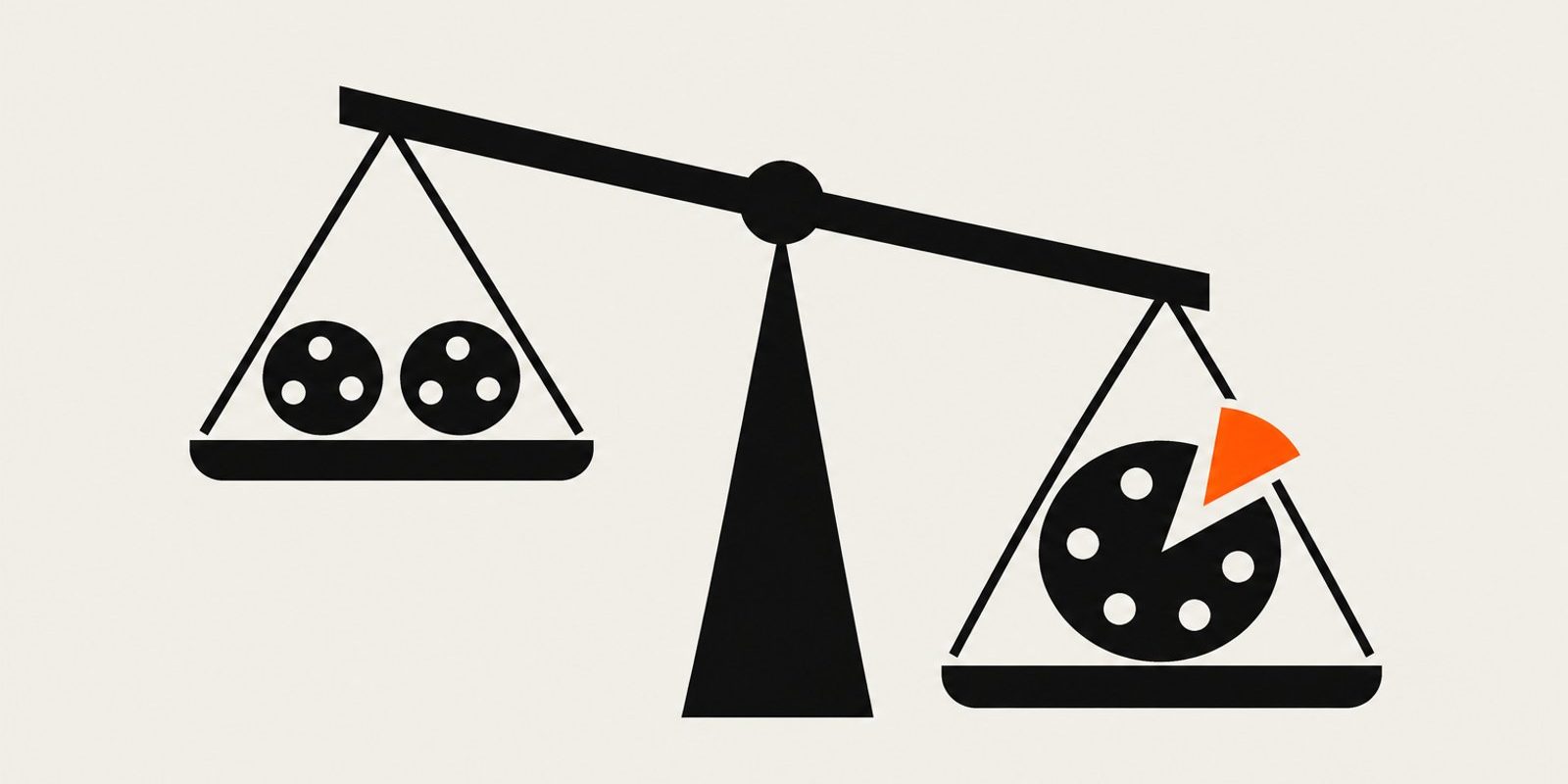
Compare an 18-inch pizza with two 12-inch pizzas. Two 12-inch pies add up to 226 square inches. One 18-inch pie is 254 square inches. The single big pizza wins by about 12.5%, even though 18 is less than 24, the sum of the two widths. (Pizzas this big are rare. Think of it as a thought experiment.)
It works at smaller sizes too. Two 10-inch pizzas hold 157 square inches. One 14-inch pizza holds 154. Same amount of pizza, one box instead of two.
What the menu says
One published guide to Domino’s hand-tossed build-your-own pizzas lists a 10-inch at $5.99, a 12-inch at $7.99 and a 14-inch at $9.99 (SixStoreys, 2025). Prices vary by store and change often, so treat these as an example, not a quote. Here is the math on them.
| Size | Area (sq in) | Price | Cents per sq in |
|---|---|---|---|
| 10-inch | 78.5 | $5.99 | 7.6¢ |
| 12-inch | 113.1 | $7.99 | 7.1¢ |
| 14-inch | 153.9 | $9.99 | 6.5¢ |
The 14-inch is only 17% wider than the 12-inch, but it holds 36% more pizza. The price rose 25%. So each square inch gets cheaper as you go up. Two 10-inch pizzas would cost $11.98 for the same food as one $9.99 14-inch.
Why your eye gets it wrong
Area is a two-dimensional idea, but we judge it with one number, the width. Researchers who studied this in six experiments found that people compare shapes by locking onto one salient dimension and then adjusting too little for the other (Krider, Raghubir and Krishna, Marketing Science, 2001). Their paper uses pizzas as the running example.
The result is that a bigger pie looks only a bit bigger, so a bigger price looks steep. You may reject the better deal because the width gap looks small and the price gap looks real.
Two extra inches of width can be a third more pizza. Your eye sees the inches. Your stomach lives in square inches.
numbergist.com, from the math above (our own line, not a quotation)
When bigger is not better
Here is where the obvious takeaway needs a brake. The cheapest square inch is only a good deal if you eat the square inches. Leftover pizza that dries out in the fridge is not a bargain. If a 12-inch fills you up, the 14-inch at a lower unit price still costs $2 more than you needed to spend.
Menus also bend the rule. Extra-large pizzas sometimes cost much more than the formula suggests, and a promotion on a smaller size can flip the ranking. A $6.99 deal on a 12-inch beats the 14-inch at full price on every measure.
Toppings matter too. Some chains charge per topping by size, so a big pizza with three toppings can lose some of its edge. And if you want two flavors, two 10-inch pizzas cost more than one 14-inch but give you two toppings. You may decide that is worth about $2.
Thickness is the other hidden variable. We have been treating every pizza as the same flat disk. A deep-dish 10-inch can hold more dough, cheese and sauce than a thin 12-inch, so square inches only compare like with like. The area rule is a clean way to size up two pizzas of the same style. It cannot tell you which crust you will love more.
How to check any menu in ten seconds
Square each diameter and compare. A 12-inch is 144. A 14-inch is 196. Divide the price by that number. The lowest result is the best deal per bite. The pi cancels out when you compare, so you can skip it.
The short version
Width is a bad guide to pizza. Square it, and the bigger pie usually wins.
For illustration only. Not financial advice.
Sources
- Krider, R. E., Raghubir, P., and Krishna, A., “Pizzas: π or Square? Psychophysical Biases in Area Comparisons”, Marketing Science 20(4), 2001. link
- SixStoreys, “Domino’s Menu and Prices” (hand-tossed build-your-own sizes and prices; page updated June 2025). link
- Cambridge Mathematics, “How much for a hole pizza?” (18-inch vs two 12-inch comparison). link