A thunderstorm rolls in over the lake. You are halfway through a fishing trip, the sky is turning the color of a bruise, and someone in the boat says what everyone says: “Relax. You’re more likely to win the lottery.”
It is a comforting line. It is also fuzzy. Which odds? Over what time? And for whom? The real numbers are stranger, and in one way kinder, than the saying suggests.
The famous number, and its newer cousin
For years the National Weather Service published lifetime odds of being struck by lightning of about 1 in 15,300. That figure came from 2009-2018 averages: roughly 27 deaths and 243 injuries a year, about 270 people in all, out of 330 million Americans, over an 80-year life (NWS, “Lightning Odds”).
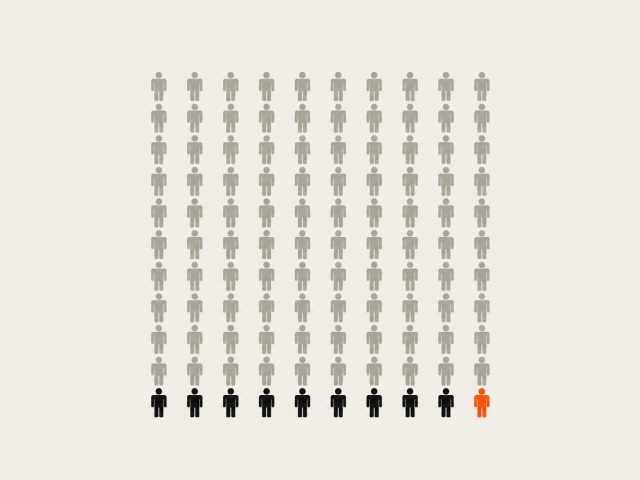
A newer NOAA version uses 2013-2022 averages and gives about 1 in 18,864 for a lifetime, and about 1 in 1,509,000 for any single year (NOAA JetStream FAQ). So “1 in a million” is a decent shorthand for one year, not for a lifetime. Both figures are population averages. They are not your personal odds.
Struck is not the same as killed
Most people who are struck survive. That is why the odds above count injuries as well as deaths. Counting deaths only, the picture shrinks again. The NWS reported 21 lightning deaths in 2025 and averaged 20 a year over 2016-2025 (NWS, “Lightning Fatalities”). Against 330 million people, that is about one death per 16 million people each year.
So a typical American faces a risk in any given year that is smaller than the “1 in a million” line suggests, if the question is dying.
A hazard that faded away
Lightning used to be far deadlier. In the 1940s it killed about 329 Americans a year. By the 1970s the figure was about 98. For 2007-2016 it averaged 31 (Chicago Sun-Times, 2017, citing NWS data). Adjusted for population growth, the death rate has fallen more than forty-fold since record-keeping began in 1940 (same source).
| Period | Average US lightning deaths a year |
|---|---|
| 1940s | about 329 |
| 1970s | about 98 |
| 2007-2016 | 31 |
| 2016-2025 | 20 |
Lightning did not get weaker or rarer. People changed. Fewer Americans farm, so fewer spend the day as the tallest object in an open field. Safety campaigns also taught a simple rule: when thunder roars, go indoors.
As a society we spend less time outside.
Harold Brooks, scientist, NOAA National Severe Storms Laboratory (Chicago Sun-Times, 2017)
Who actually gets hit
Averages hide a lopsided pattern. Across 2016-2026, the NWS counted 172 male and 40 female lightning deaths. That is about 81% men. The National Lightning Safety Council’s John Jensenius says fishing causes more lightning deaths than any other activity: 44 deaths from 2006 through April 2025, of whom 41 were men (USA TODAY, 2025). A likely reason is time. Getting from a boat or lakeshore to real shelter takes a while.
The 2026 list so far is a mix of ordinary moments: hiking, walking to a vehicle, kayaking, cutting the lawn, trimming trees (NWS, 2026, preliminary).
The twist: a tiny average can be a big personal risk
Here is where the “more likely to win the lottery” comfort fails. An average spreads the risk over all 330 million of us, including people who are asleep indoors during every storm. Someone who spends summer afternoons on open water or a ridge has a very different exposure. The NWS says plainly that individual odds vary with location, time of day, season and lifestyle (NWS, “Lightning Odds”).
The number is also less stable than it looks. The old and new lifetime figures differ by about 23%, just from swapping one decade of data for the next. And annual deaths bounce: 40 in 2016, 11 in 2021, 21 in 2025 (NWS). A single bad year can move an average a lot when the total is this small.
| Question | Rough answer |
|---|---|
| Struck in a lifetime (80 years) | 1 in 18,864 (NOAA, 2013-2022) |
| Struck in one year | 1 in 1,509,000 (NOAA) |
| Killed in one year | about 1 in 16 million (20 deaths, 330M people) |
The last row is our own division, using the 330 million population the NWS used.
What the numbers really say
Lightning is rare, and rarer than it was. But “rare” describes the crowd, not the person on the lake. The odds got better because millions of people changed what they do when the sky darkens.
Small odds are an average. Your afternoon is not.
Sources
- National Weather Service, “Lightning Odds” (annual 1 in 1,222,000 and lifetime 1 in 15,300, 2009-2018 averages), accessed 2026. link
- NOAA JetStream, “Lightning Frequently Asked Questions” (1 in 18,864 lifetime; 1 in 1,509,000 annual; 2013-2022), accessed 2026. link
- National Weather Service, “Lightning Fatalities” (deaths by year 2016-2026, sex split), accessed 2026. link
- Chicago Sun-Times, “Lightning is zapping fewer Americans, not more, science says”, 2017. link
- Doyle Rice, USA TODAY, “Most fatal lightning strikes kill people doing this routine activity”, 2025 (republished by AOL). link