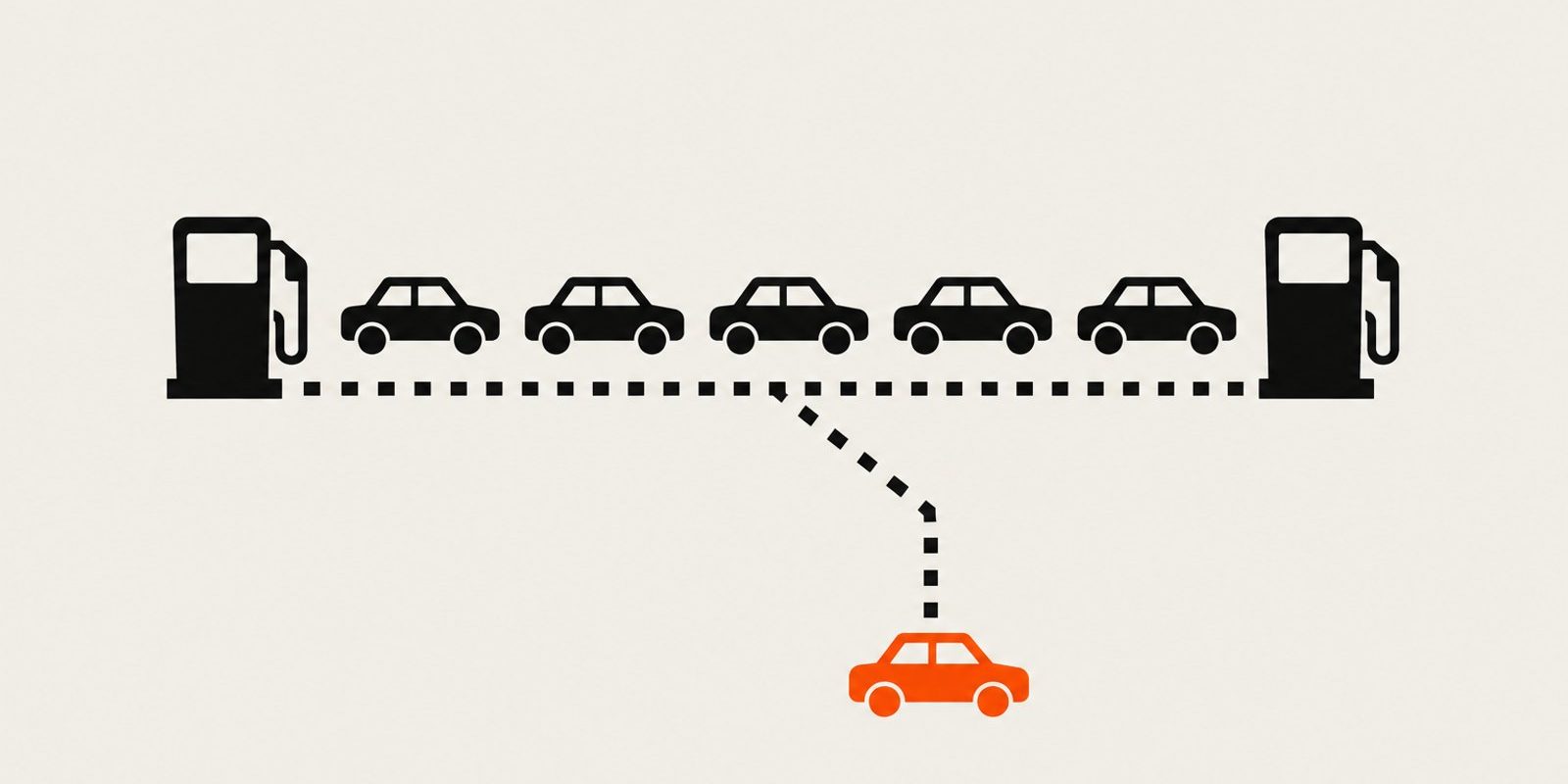
The gas sign across town says 10 cents a gallon cheaper than the one at the corner. You can almost feel your wallet getting heavier. All it costs you is a short drive in the wrong direction.
Is it worth it? The answer is in a small bit of arithmetic, and it points to a rule you can use at any pump.
What a mile of driving really costs
Start with the fuel your car burns on the detour. The average new vehicle in model year 2024 got a record 27.2 miles per gallon in real-world driving (EPA, 2026). The average US price of regular gasoline was $3.642 a gallon for the week ending November 23, 2026 (EIA).
Divide the price by the mpg: $3.642 divided by 27.2 is about 13.4 cents per mile. AAA reached nearly the same number. Its 2025 study put fuel at 13.00 cents per mile, using a gas price of $3.151 a gallon (AAA, 2025).
Fuel is not the only cost of driving. Tires, maintenance and wear on the car add to it, and AAA counts those too. We use fuel only here, so treat 13 cents as the floor for the true cost of a mile.
The 10-cent test
Now say the cheaper station sits 5 miles out of your way in total. A detour like that burns about 5 times 13.4 cents, which is 67 cents of fuel.
What do you save? That depends on how much you buy. Assume a 12-gallon fill-up, an assumption for this example, since tank sizes and how empty you run vary. Ten cents times 12 gallons is $1.20.
Net result: $1.20 saved minus 67 cents spent, or about 53 cents. And the detour takes maybe 10 minutes at 30 mph. That works out to roughly $3 an hour. Not a great wage.
| Price gap per gallon | Saved on 12 gallons | Break-even extra miles | Roughly, minutes at 30 mph |
|---|---|---|---|
| 5 cents | $0.60 | 4.5 | 9 |
| 10 cents | $1.20 | 9.0 | 18 |
| 20 cents | $2.40 | 17.9 | 36 |
| 30 cents | $3.60 | 26.9 | 54 |
The break-even column is the most extra distance you can drive before the detour costs more than it saves. It is the savings divided by 13.4 cents.
The rule of thumb
Here is the shortcut. At today’s prices, every extra mile costs about 13 cents in fuel, and every cent of price gap saves you about 12 cents on a 12-gallon fill. So each 1 cent of savings per gallon buys you roughly one extra mile of detour. A 10-cent gap supports about 9 miles. A 5-cent gap supports about 4 or 5.
It is worth noting that smaller fill-ups cut this in half. If you only add 6 gallons, a 10-cent gap saves 60 cents, and the break-even drops to about 4.5 miles.
A cent a gallon buys about a mile of detour. After that, you are paying for the discount.
numbergist.com, from the math above (our own line, not a quotation)
When the cheap pump is on your way
The math flips if the cheaper station is already on your route. Then the detour is zero miles and every cent saved is yours. That is the real trick: it is not “is the cheap gas worth a drive?” but “can I fill up where I am already going?”
Your time is the other side of the ledger. Even when the break-even miles work in your favor, you may spend 18 minutes to save $1.20. Whether that is worth it is a personal call. If you value your time at $15 an hour, 18 minutes is $4.50, more than the whole saving.
Where the numbers get fuzzy
Your car is not the average car. A truck at 18 mpg spends about 20 cents a mile on fuel, so its break-even is shorter. A hybrid at 50 mpg spends about 7 cents, so it can go farther. Traffic, hills and stop-and-go driving all push fuel use up, and the 27.2 figure is for new vehicles, not the average car on the road.
Prices also change from week to week. When gas gets more expensive, a mile costs more, so the break-even distance shrinks. At $4.50 a gallon and 27.2 mpg, a mile costs 16.5 cents and a 10-cent gap supports about 7 miles.
The short version
Ten cents off a gallon is worth about nine extra miles, if you fill the tank. Past that, the discount costs more than it saves.
For illustration only. Not financial advice.
Sources
- U.S. Environmental Protection Agency, “Highlights of the Automotive Trends Report” (model year 2024 real-world fuel economy 27.2 mpg), updated February 2026. link
- AAA, “AAA: New Vehicle Costs Drop to $11,577” (fuel cost 13.00 cents per mile; $3.151 gas; 15,000 miles a year), September 16, 2025. link
- U.S. Energy Information Administration, weekly retail gasoline prices, regular all formulations, week ending November 23, 2026. link