Picture the biggest crowd you have ever stood in. A packed stadium, a New Year’s Eve street, a concert where you could not turn around without bumping someone.
Now picture every human being on Earth in that same crowd, all at once. How much ground would you need? Less than you might guess, and the answer says as much about empty space as about people.
Packing in 8.2 billion people
The United Nations estimated the world population at about 8.2 billion in mid-2024 (UN DESA, World Population Prospects 2024). To find standing room, we need a crowd density. Crowd-safety guidance describes about 4 people per square meter as a very tight crowd where you may have to push others aside to move, and about 5 per square meter as the point where crush risk begins (Cambridgeshire event guidance, drawing on Keith Still’s work). Those are rough guides, not laws of nature.
At 5 people per square meter, 8.2 billion people need 1.64 billion square meters. That is 1,640 square kilometers, or about 633 square miles. At a slightly looser 4 per square meter, it is about 2,050 square kilometers, or roughly 790 square miles.
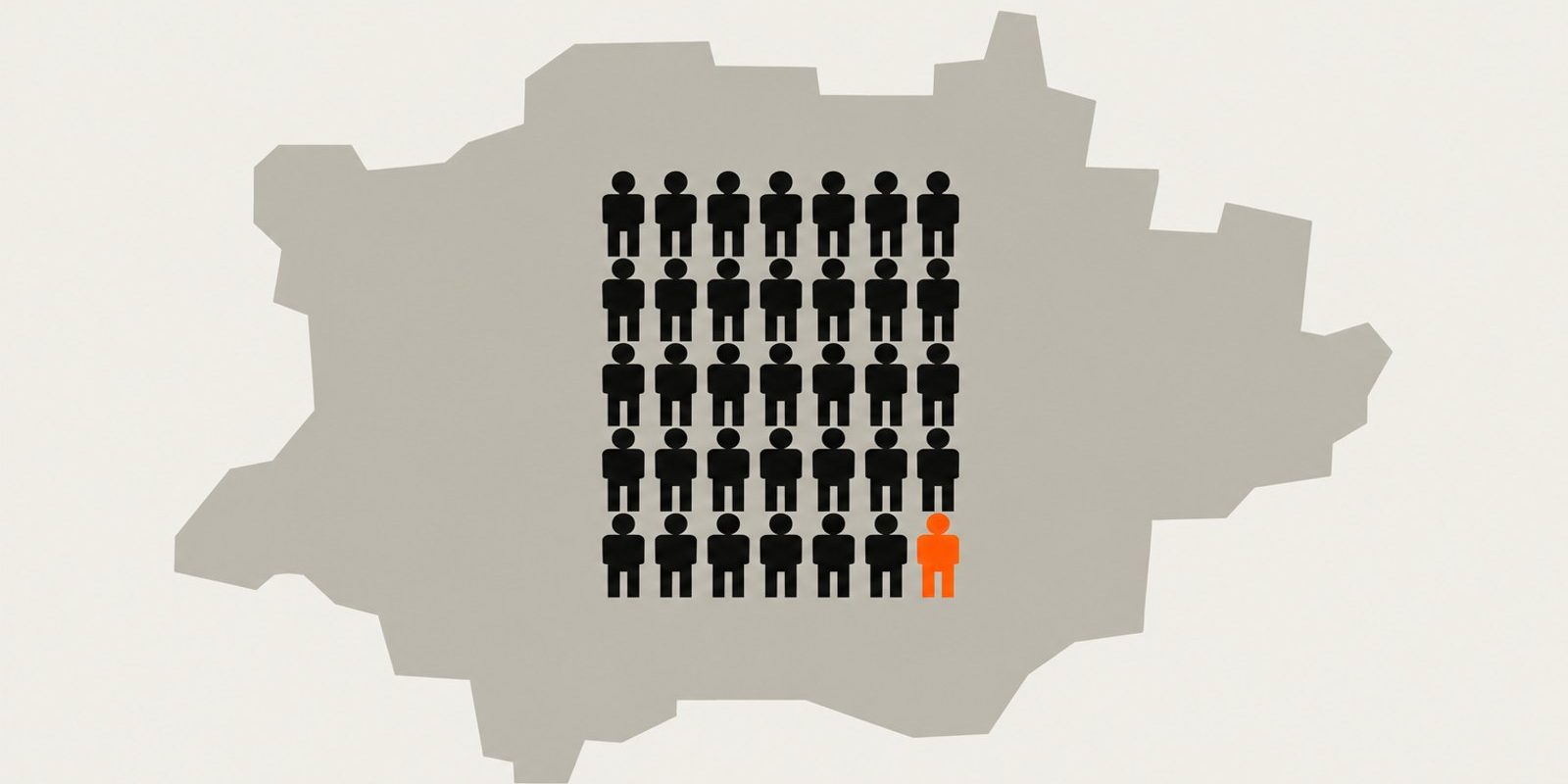
A crowd the size of Houston
The city of Houston covers about 640 square miles of land (Census Bureau QuickFacts, 2020). So the entire human race, packed as tightly as people can stand for a moment, would just about fit inside the Houston city limits. At the looser density, you would need a bit more than Houston, but still a tiny slice of Texas, which has 261,232 square miles of land (Census Bureau, 2010 state area measurements). The tight crowd would take up about a quarter of one percent of it.
Another way to see it: Rhode Island has 1,034 square miles of land (Census Bureau). The crowd at 5 per square meter would fill about three-fifths of it. At 4 per square meter, about three-quarters.
| Crowd density | Area needed | Compared with |
|---|---|---|
| 5 people per sq m | 1,640 sq km (633 sq mi) | About 99% of Houston’s land area |
| 4 people per sq m | 2,050 sq km (792 sq mi) | About 77% of Rhode Island’s land area |
Now give everyone a home
Standing shoulder to shoulder is a party trick. Nobody lives that way. So run the numbers again with something realistic.
The US Energy Information Administration reports that American homes averaged about 741 square feet of floorspace per household member in 2020 (EIA, Residential Energy Consumption Survey, 2020). Give all 8.2 billion people that much indoor space and you need about 6.1 trillion square feet. That is roughly 218,000 square miles of floors.
That is about 344 times as much space as the standing crowd. It is also about 83% of the land area of Texas, or about 1.4 times the land area of California (155,779 square miles, Census Bureau). Remember, that counts only floors. Stack them in tall buildings and the footprint shrinks.
The whole human race fits in one city. It just would not enjoy it.
Our own line, not a quote from a source
Why this is a trick question
Here is the catch. This is a fun comparison, not a plan, and it is easy to take the wrong lesson from it. Some people use “everyone fits in Texas” to argue that the planet is empty and crowding is not a problem. The math is correct, but it measures the wrong thing.
People do not only need a place to stand. They need food, water, energy and farmland. Those take up far more room than we do. The crowd picture does not show that there is plenty of space for people. It shows that the space people occupy directly is tiny, and almost everything else we use is spread out across the rest of the map.
The home-space estimate has its own limits. The EIA figure is an average for US households, and its definition of floorspace may not match other countries’ data (EIA, 2020). Applying an American average to the world is an illustration, not a forecast. Many people on Earth live in far less space, and some in far more.
The takeaway
Use two pictures together. In the first, all of humanity stands on a patch of land about the size of a big American city. In the second, the same people live at American home sizes and need floors covering most of Texas. The distance between those two pictures is what “how much room we take” really means.
Everyone alive fits in Houston, but nobody lives like that.
Sources
- United Nations DESA, Population Division, “World Population Prospects 2024”, 2024. link
- US Energy Information Administration, “2020 Residential Energy Consumption Survey, Table HC10.9: Total square footage”, 2020. link
- US Census Bureau, “State Area Measurements and Internal Point Coordinates”, 2010. link
- US Census Bureau, “QuickFacts: Houston city, Texas”, land area in square miles, 2020. link
- Cambridgeshire event guidance, “Event crowd density descriptor” (based on Keith Still’s crowd-density work). link