You are on a long, empty stretch of highway. The speed limit says 70, the car beside you slides past at 80, and a small voice in your head says: why not? Ten more miles an hour has to buy you something real.
It does. It just buys a lot less than it feels like. Let’s put a stopwatch on it.
The stopwatch version
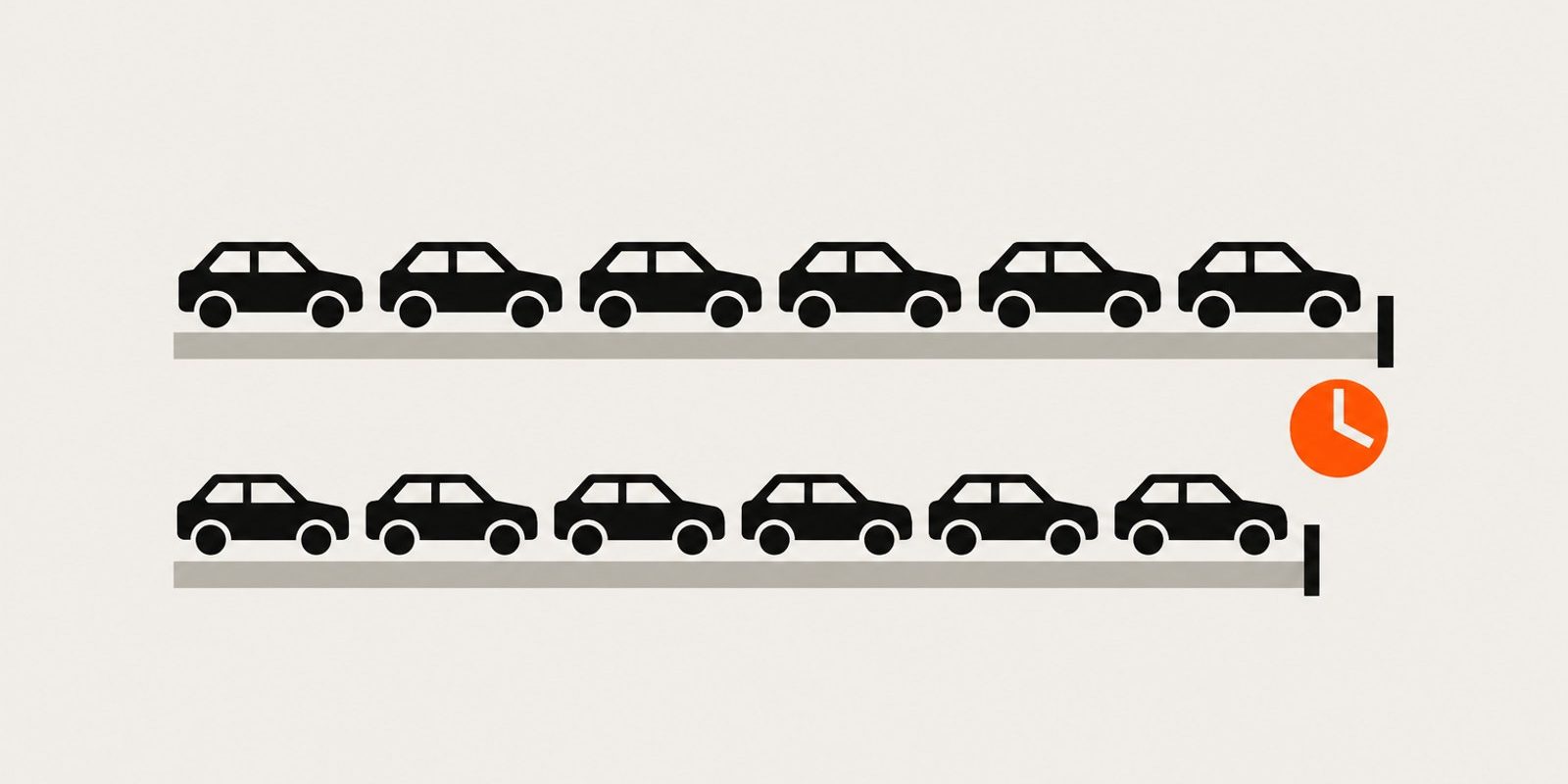
Take a 30-mile trip. At a steady 70 mph, it takes about 25 minutes and 43 seconds. At a steady 80 mph, it takes 22 minutes and 30 seconds. The difference is about three minutes and 13 seconds.
That is the whole prize for a 14% jump in speed: roughly the time it takes to sit through one red light and half of another. And that is the best case, with no traffic, no construction and no exit ramps.
| Steady speed | Time for 30 miles | Saved vs. 70 mph |
|---|---|---|
| 60 mph | 30:00 | 4:17 slower |
| 70 mph | 25:43 | — |
| 75 mph | 24:00 | 1:43 |
| 80 mph | 22:30 | 3:13 |
| 85 mph | 21:11 | 4:32 |
Notice the pattern. Each extra 5 mph saves less than the one before it. Going from 70 to 75 saves 1 minute 43 seconds. Going from 75 to 80 saves only 1 minute 30 seconds. The faster you already go, the less each extra mile per hour is worth.
What the average commute looks like
The average American worker’s one-way trip to a workplace took 26.4 minutes in 2022 (Census Bureau, 2024). Suppose, generously, that you could hold 80 mph instead of 70 for that entire trip. You would arrive about 3 minutes earlier (26.4 × 70 ÷ 80 = 23.1 minutes).
In real life you cannot. Most commutes are stop signs, lights, ramps and slower traffic. The real gain is smaller, often a minute or less. The stopwatch is honest, but it only runs at the speed of the slowest thing in front of you.
The fuel bill
Air pushes back harder the faster you go. The U.S. Department of Energy says gas mileage “usually decreases rapidly” above 50 mph, and that each 5 mph over 50 is like paying an extra $0.25 per gallon for gas (DOE, fueleconomy.gov; the figure traces to a 2013 Oak Ridge National Laboratory study using 2003–2012 model-year vehicles).
Use that rule of thumb and the gap between 70 and 80 is two steps of 5 mph, so about $0.50 per gallon. Say your car gets 25 miles per gallon, an assumption for this example. The 30-mile trip burns 1.2 gallons, so the extra cost is about 60 cents. Your three minutes cost roughly 19 cents each, or about $11 for an hour of time saved. The rule is an approximation, and your car will differ.
The part that is not on the dashboard
Crash energy grows with the square of speed. Divide 80 squared by 70 squared and you get 1.31. A crash at 80 mph carries about 31% more energy than one at 70. The Insurance Institute for Highway Safety gives a bigger example: raise impact speed from 40 to 60 mph, a 50% increase, and the energy to be managed rises 125% (IIHS).
The national picture is sobering. In 2024, 11,288 deaths, or 29% of all motor vehicle fatalities, happened in speed-related crashes (IIHS, 2024). IIHS also links each 5 mph increase in a state’s maximum speed limit, over 1993–2017, to an 8% rise in interstate and freeway fatality rates.
Ten extra miles an hour buys you a coffee break’s worth of minutes and 31% more crash energy.
numbergist.com, from the math above (our own line, not a quotation)
When speeding does matter
Here is the honest complication. Minutes add up on long trips. On a 300-mile drive, 80 instead of 70 saves about 32 minutes, ten times the 30-mile result. For a long haul, that is a real difference, and it explains why people do it.
But the cost grows too. The fuel penalty scales with distance, and crash risk exists every minute you are driving fast, not just at the end. The trade is smaller than it feels per mile, and it stays a trade every mile.
Context matters as well. A few mph over on an empty, dry road is a different thing from 80 in rain or heavy traffic. The numbers above assume steady speeds in ideal conditions, which is exactly why they flatter speeding. Real roads give you less time back and less room for error.
The short version
Three minutes. Sixty cents. Thirty-one percent more energy if things go wrong. The clock is a worse bargain than your gut thinks.