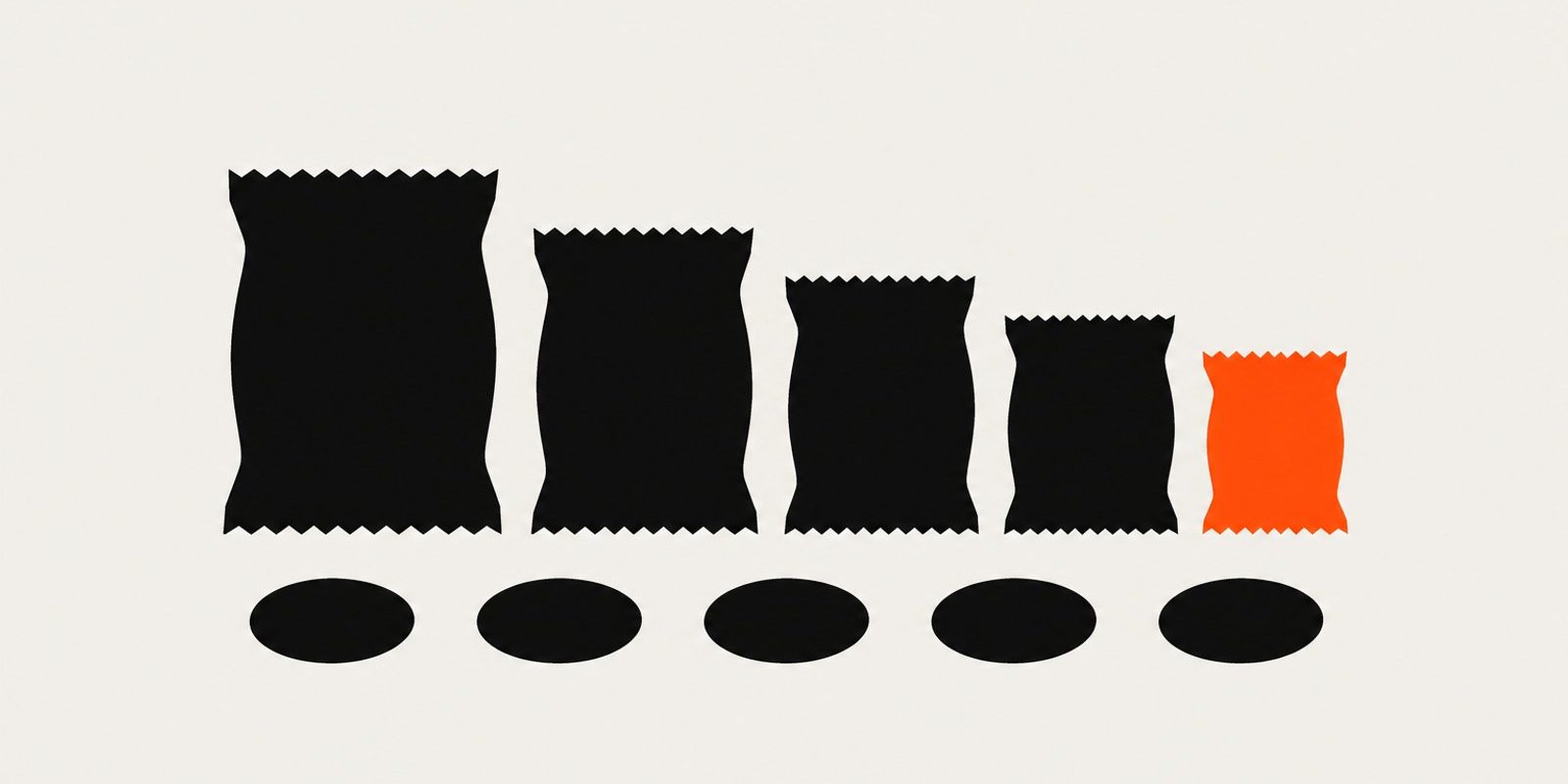
You grab your usual bag of chips. The price tag says $4.00, same as last month. The bag feels light, but you cannot say why. You check the label. It used to say 16 ounces. Now it says 14.
Nothing on the shelf announced a price rise. Yet you just paid more. The trick has a name: shrinkflation. And the math to catch it takes about ten seconds.
The ten-second math
Price per ounce is price divided by size. Before: $4.00 ÷ 16 oz = 25 cents an ounce. After: $4.00 ÷ 14 oz = 28.6 cents an ounce. That is a 14.3% price rise, with the sticker price untouched.
There is a shortcut. Divide the old size by the new size and subtract 1. For the chips: 16 ÷ 14 − 1 = 0.143, or 14.3%.
Notice that the rise is always bigger than the shrink. The bag lost 12.5% of its chips, but the price per chip rose 14.3%. You are paying the same money for a smaller base.
| Package shrinks by | Same price, hidden rise in price per unit |
|---|---|
| 5% | 5.3% |
| 10% | 11.1% |
| 15% | 17.6% |
| 20% | 25.0% |
How the government counts it
You might expect official inflation numbers to ignore a shrunken package. They do not. The Bureau of Labor Statistics (BLS) divides each price by the package size and tracks the price per ounce, or per sheet, or per count.
BLS gives an example. A half-gallon (64 ounces) of ice cream costs $5.99 in January. In February the carton holds 60 ounces and still costs $5.99. The price per ounce goes from about 9.4 cents to about 10.0 cents. BLS counts that as a 6.7% price increase in the Consumer Price Index. A toilet paper roll that drops from 220 to 200 sheets counts as a 10% increase in price per sheet (BLS, 2023).
The surprise: it is real but small overall
From 2015 to 2019 the published CPI for all items rose 9.44%. A research version that removes size changes rose 9.39%. The difference is 0.05 percentage points over five years. For food and beverages it was 0.21 points, the largest of any major group (BLS, 2023).
A federal watchdog found something similar for a later period. Between 2019 and 2024 overall consumer prices rose 34.5%. Downsizing accounted for less than a tenth of one percentage point of that (U.S. Government Accountability Office, 2025).
A smaller bag is a price rise wearing a disguise. A small one, on average. A big one, on a few shelves.
Our own line, not a quotation
Where it bites
The effect is concentrated. Over 2015 to 2021, household paper products, such as paper towels and toilet paper, had the most size changes of any category, with 716 reports and 1.79% of observed prices downsized. Among foods, snacks led, with 509 reports and 0.54% of prices downsized (BLS, 2023).
GAO looked at store purchase data from 2021 to 2023 in seven categories. In each, fewer than 5% of items were downsized. But those items had a larger slice of the sales. In cereal, 1.1% of items were downsized, and they made up 8.6% of cereal sales (GAO, 2025). So the products that shrink can be the popular ones.
Why you miss it
GAO notes that research suggests shoppers respond less to a smaller package than to an equal price increase. Possible reasons include subtle packaging changes, infrequent purchases and strong brand loyalty (GAO, 2025). BLS adds that a new package design can hide the change in amount.
Your best tool: the unit price
The small number on the shelf tag, usually in the corner, is the price per ounce, per sheet or per count. It lets you compare a shrunken box against a rival brand or the same product last month, if you wrote it down.
It is not a magic fix. Unit pricing is not required by federal law. According to NIST, whether stores must show it is decided state by state, usually by adopting model rules in NIST Handbook 130. GAO says a national unit price rule could help shoppers compare even if they never notice a shrink, but enforcement would probably fall to the states.
When the cheaper unit price is not cheaper
Lower per-ounce prices can still cost you more. A giant bag of something you throw out half of is not a bargain. Unit price compares price per unit. It cannot measure how much you will actually use.
The habit worth keeping is simple: read the size, not just the price.
Sources
- Kari McNair, U.S. Bureau of Labor Statistics, “Getting less for the same price? Explore how the CPI measures ‘shrinkflation’ and its impact on inflation”, Beyond the Numbers, Vol. 12, No. 2, February 2023 (with later appendix). link
- U.S. Government Accountability Office, “Consumer Prices: Trends and Policy Options Related to Shrinking Product Sizes” (GAO-25-107451), July 31, 2025. link
- NIST, Handbook 130, Section IV.C “Uniform Unit Pricing Regulation” and NIST SP 1181, 2025. link