
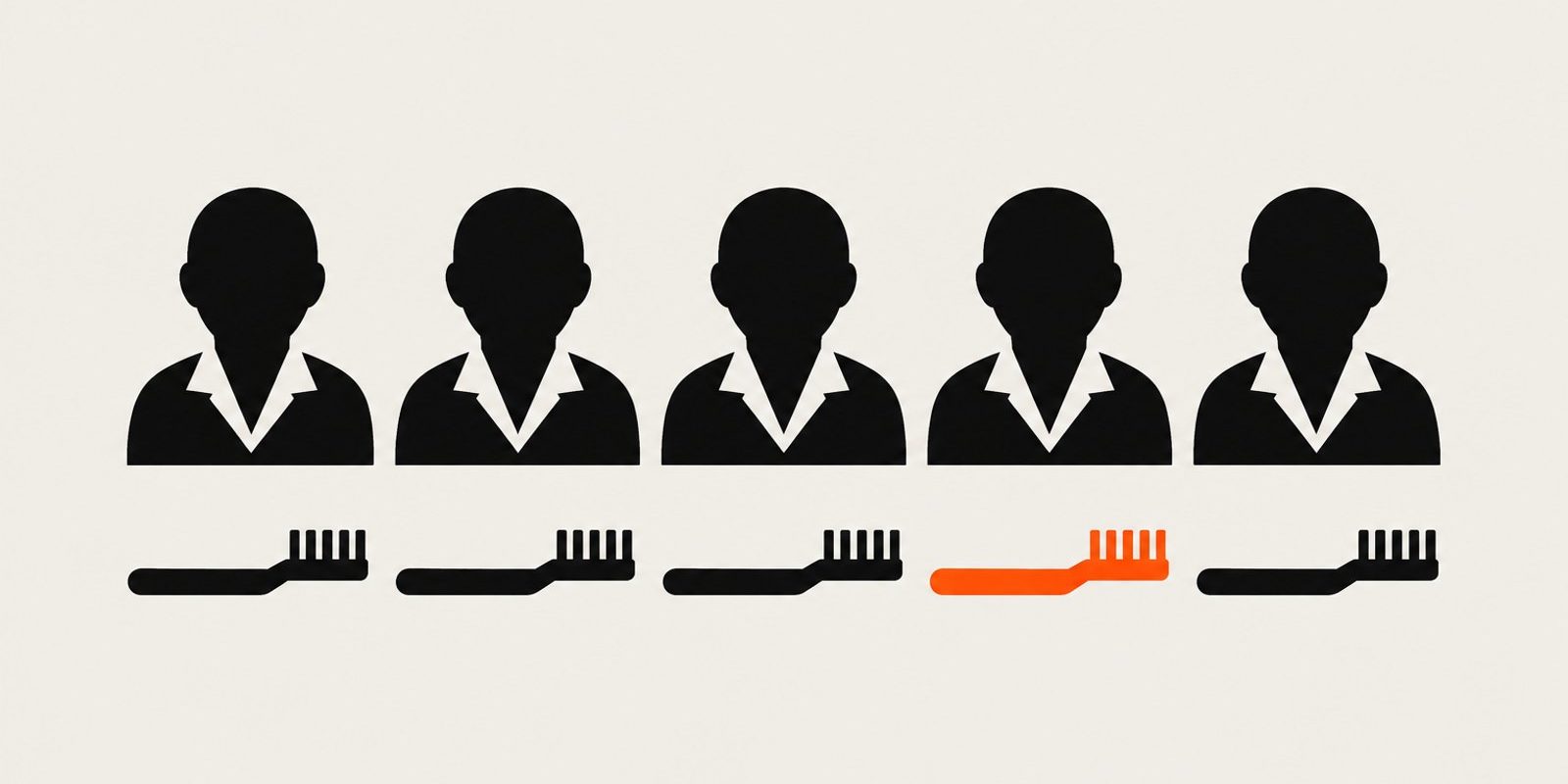
You are standing in a drugstore aisle, holding two tubes of toothpaste. One box says dentists recommend it. That sounds like a vote. Dentists lined up, and most of them picked this tube.
It usually was not a vote like that. The most famous legal test of the line happened in Britain in 2007, and it turned on one small detail: how many answers each dentist was allowed to give.
The poster that got pulled
In January 2007, a Colgate poster for its Total Advanced Fresh toothpaste carried the headline “More than 80% Of Dentists recommend Colgate.” A second line called the brand “used and recommended by most dentists” (Osborne Clarke, 2007).
Two people complained to the UK’s Advertising Standards Authority (ASA). The regulator agreed with them. It read the poster the way most shoppers would: 80% of dentists picked Colgate over the other brands. The survey never asked that question.
What the survey really asked
Dentists and hygienists in the survey were asked to recommend several toothpastes and brands. They were not asked for a single favorite. Another brand was recommended almost as often as Colgate (Osborne Clarke, 2007).
Picture a bakery that asks five customers, “Which of these do you like: bagels, muffins, scones?” Say four of them like all three. Then 80% like bagels, 80% like muffins and 80% like scones. Every item can honestly claim “4 out of 5 recommend.” None of them won anything.
The ASA upheld both complaints. It found the claim was not backed by the evidence, and that it implied a professional endorsement the people surveyed had not clearly given. Four code clauses were cited: substantiation, truthfulness, testimonials and endorsement (Osborne Clarke, 2007).
Two questions, one sentence
| What dentists were asked | What the ad seemed to say |
|---|---|
| Which of these brands would you recommend? (several allowed) | Which one brand do you recommend most? |
| Can many brands score 80%? Yes. | Can many brands score 80%? No. Only one leads. |
| Result: a list of acceptable options | Result: a winner |
Where “4 out of 5” came from
The Colgate poster said “more than 80%,” not “4 out of 5.” The famous “four out of five dentists” wording is usually tied to Trident sugarless gum. The story goes that a survey of practicing dentists found about 80% would recommend sugarless gum to patients who chew gum. One reference work calls that survey “believed” and “apparently” run in the early 1960s, and it names no primary source (Wikipedia, “Trident (gum)”).
So the origin is shaky. What is solid is the structure. In the gum version, the question was about a product type: would you recommend sugarless gum? That is a very different claim from “dentists prefer our brand.”
When every contestant is allowed to win, “most experts recommend us” tells you almost nothing.
numbergist.com (our own line, not a quotation)
The twist: it may not have been a lie
Here is the honest complication. Nobody showed that the survey numbers were invented. Many dentists probably did recommend Colgate. The problem was the picture the sentence painted, not the raw count. Described accurately, the result might read: “most dentists we surveyed would recommend Colgate, and also several other brands.” That is true. It is also a weak slogan.
This is why regulators ask what a reasonable shopper will take away, not only whether each word can be defended. A true number can still mislead.
How to read any “X out of Y” claim
Ask who was surveyed: dentists, hygienists, or only people who chose to answer? Ask what the question was. “Do you recommend it?” is far easier to pass than “Which is best?” Ask whether rivals could post the same score. If they can, it is not a ranking.
Ask how many were asked, too. Four out of five could be literally five people. And ask who paid for it, since advertisers choose the questions.
Verdict
Misleading, as most people read it. The 2007 UK ruling found that the “80% of dentists” claim implied a preference the survey did not measure. A slogan can be built from honest answers and still leave the wrong impression.
Next time a box says experts recommend it, ask one thing: recommend it over what?