
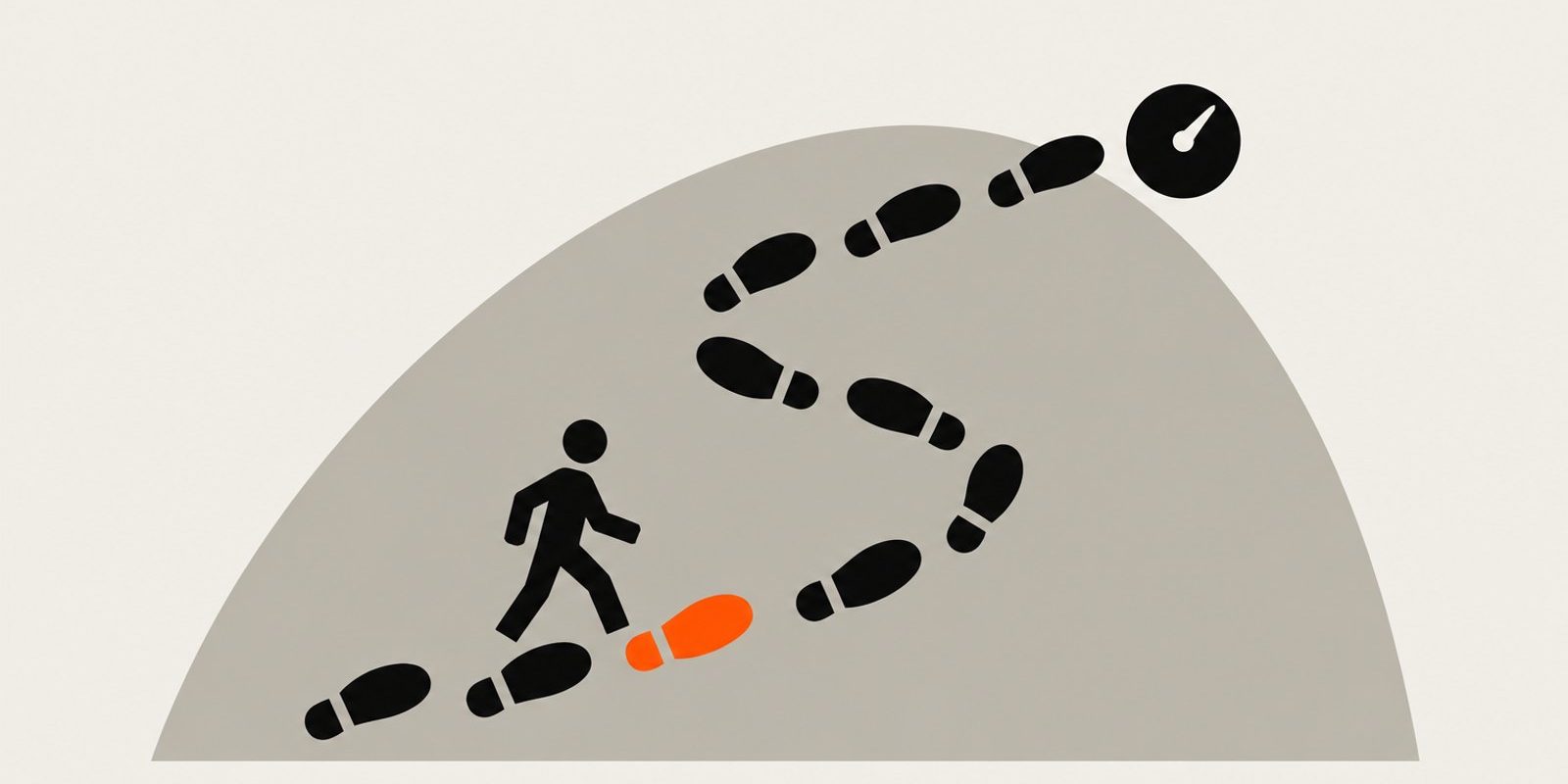
Your wrist buzzes at 9:40 at night. You are at 6,300 steps. So you pace the living room, loop the kitchen island twice and walk to the mailbox you were not going to check. Why stop at 10,000? Because that is the number the watch picked.
The number is so familiar that it feels like it came from a lab. It did not. This is a look at what the research says, not medical advice.
The verdict
Verdict: invented as marketing, but not a bad idea. The 10,000-step goal was not derived from a health study. Research since then does link more steps to lower death rates, but the benefit appears to level off well below 10,000 for many people.
Where 10,000 came from
In 1965, according to Popular Science, the Japanese company Yamasa Tokei Keiki released one of the first consumer pedometers. It was called the Manpo-kei, which translates to “ten-thousand step meter.” The article ties the launch to worries after the 1964 Tokyo Olympics that the public was not moving enough (Popular Science, 2025).
Harvard epidemiologist I-Min Lee told the magazine there were no actual studies of “10,000 steps” when the device was developed. She called it “a made-up number in the sense that 10,000 sounds good, it’s easy to remember.” She also noted that the Japanese character for 10,000 looks a little like a person walking (Popular Science, 2025).
Sources disagree about the people behind the number. Some accounts credit a Tokyo doctor and some an engineer. I could not confirm any of those names from a primary source, so I am leaving them out. What is well supported is the marketing origin and the lack of a study behind it.
The first real test
In 2019, Lee and colleagues put the question to data. They gave accelerometers to women in the Women’s Health Study and tracked them. The analysis covered 16,741 women with an average age of 72, followed for just over four years, during which 504 died (Harvard Gazette, 2019).
The least active quarter averaged about 2,700 steps a day. Women averaging about 4,400 steps had a 41 percent lower risk of death. The risk kept falling until about 7,500 steps a day, then leveled off (Harvard Gazette, 2019; Lee et al., JAMA Internal Medicine, 2019). How fast the women walked did not show a clear link to mortality once total steps were counted (Lee et al., 2019).
Even a little more is helpful.
I-Min Lee, Harvard epidemiologist (Harvard Gazette, 2019)
Bigger studies since
A 2022 meta-analysis of 15 international cohorts found that risk fell with more steps until about 6,000 to 8,000 steps a day for adults 60 and older, and 8,000 to 10,000 for adults under 60 (Paluch et al., Lancet Public Health, 2022). A 2025 review in the same journal pooled 31 studies from 24 cohorts. It found that 7,000 steps a day was linked to a 47 percent lower risk of dying from any cause than 2,000 steps (Lancet Public Health, 2025).
| Study | Who | Finding |
|---|---|---|
| Lee et al., 2019 | 16,741 women, average age 72 | Benefit leveled off near 7,500 steps |
| Paluch et al., 2022 | 15 cohorts | Leveled off at 6,000-8,000 (age 60+) and 8,000-10,000 (under 60) |
| 2025 review | 24 cohorts in meta-analysis | 7,000 steps vs 2,000: 47% lower mortality risk |
The part that complicates the debunk
These are observational studies. People who walk more may differ in many other ways, such as being healthier to begin with. The authors of the 2019 study tried to address this by excluding women with heart disease, cancer, diabetes or poor self-rated health, but they could not fully rule it out. The cohort was mostly older white women, so the results may not carry over to everyone (Harvard Gazette, 2019).
It also matters what is being measured. These studies look at death rates, not at mood, fitness, sleep or how people feel. And “leveling off” does not mean extra steps hurt. For many younger adults, the pooled data show risk still falling toward 8,000 to 10,000. So 10,000 turns out to be a fine ceiling to aim at and a poor line between “enough” and “not enough.”
Note on the 2025 review: I was able to read only its abstract-level summary, so I have not checked its other findings in the full text.
Why 10,000 stays
Round numbers win. It is easy to remember, easy to set on a device and it sounds ambitious. A target of 7,000 is probably closer to what the pooled studies show, but it does not fit on a progress ring as nicely.
The takeaway
The number was born in an ad, not a lab. The research found more steps help, with the biggest gains coming early.
Sources
- Lauren Leffer, “No, you don’t need 10,000 steps a day”, Popular Science, August 7, 2025. link
- I-Min Lee et al., “Association of Step Volume and Intensity With All-Cause Mortality in Older Women”, JAMA Internal Medicine, 2019. link
- Harvard Gazette, “For older women, just 7,500 steps a day lowers mortality”, 2019. link
- Paluch et al., “Daily steps and all-cause mortality: a meta-analysis of 15 international cohorts”, Lancet Public Health, 2022. link
- “Daily steps and health outcomes in adults: a systematic review and dose-response meta-analysis”, Lancet Public Health, 2025. link