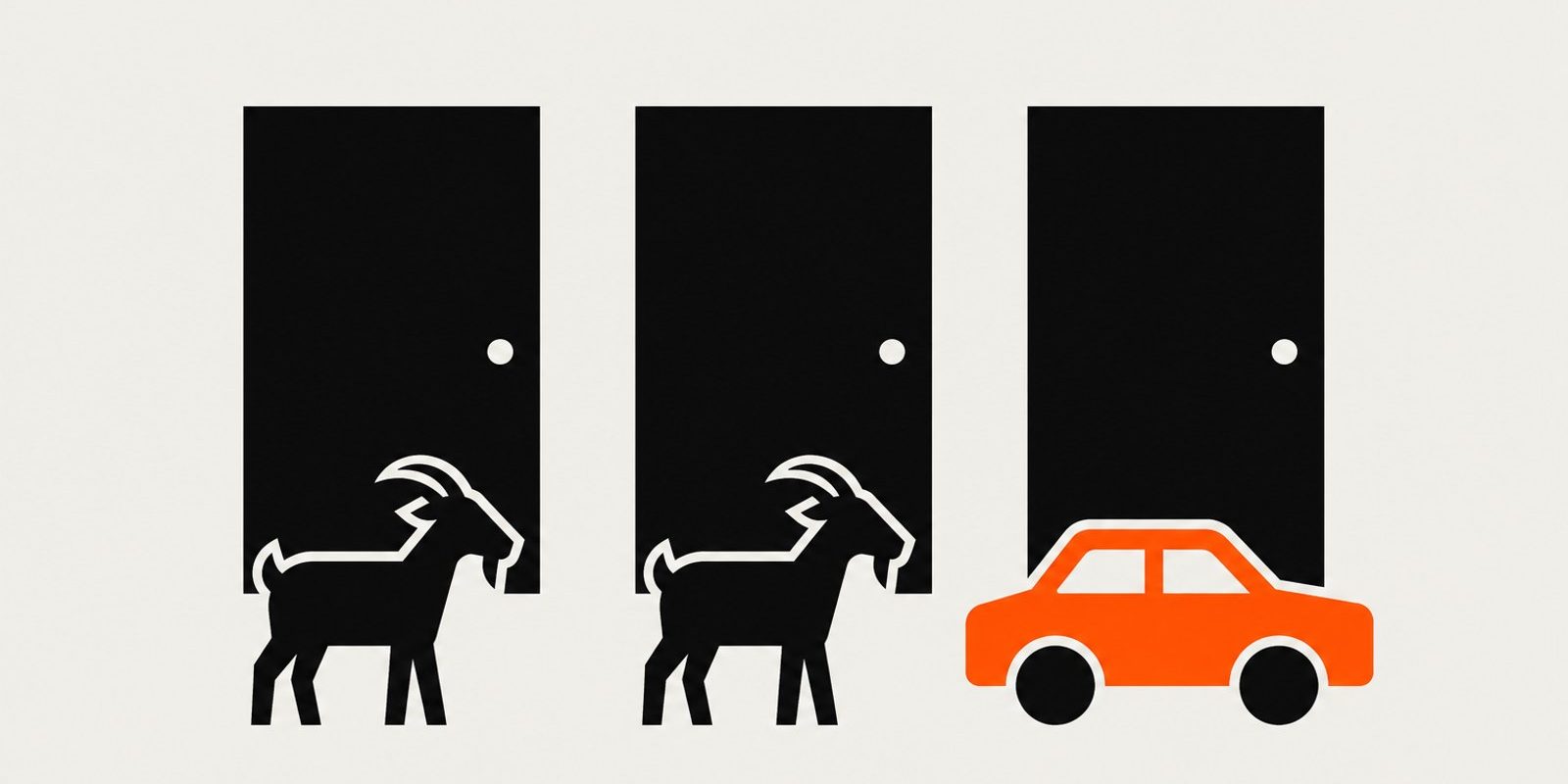
Three doors stand on a stage. Behind one is a car. Behind the other two are goats. You pick door number one. The host, who knows where the car is, opens door number three. A goat. Then he smiles and asks: “Do you want to switch to door number two?”
Most people stay. It feels like a coin flip between two doors, so why bother? In September 1990, columnist Marilyn vos Savant told readers of Parade magazine to switch. Her answer was right. Thousands of readers were sure it was wrong.
The answer: switch, and win two times in three
Under the standard rules, switching wins the car 2 out of 3 times. Staying wins 1 out of 3. Those rules matter, and we will come back to them: the host always knows where the car is, always opens a door with a goat, and always offers the switch.
Here is the simplest way to see it. When you first pick, you have a 1 in 3 chance of being right and a 2 in 3 chance of being wrong. The host’s move does not change that. He cannot open your door, and he never opens the car’s door. So if you started on a goat, the host is forced to reveal the only other goat, and the car is behind the door left over. Switching therefore wins every time you started wrong. You start wrong 2 out of 3 times.
The mail that poured in
Vos Savant estimated that about 10,000 readers wrote in, nearly 1,000 of them signed by people with PhDs, and most of the letters said she was wrong (Wikipedia, “Monty Hall problem”). Some came on the letterhead of university math and science departments. The angry mail was confident and often condescending. The math, though, was on her side.
Even the famously prolific mathematician Paul Erdős is reported to have stayed unconvinced until he was shown a computer simulation (Vazsonyi, 1999, as cited by Wikipedia). If that is true, he is in good company. Cognitive psychologist Massimo Piattelli-Palmarini wrote of the puzzle:
No other statistical puzzle comes so close to fooling all the people all the time.
Massimo Piattelli-Palmarini, cognitive psychologist (quoted in vos Savant, The Power of Logical Thinking, via Wikipedia)
Make it 100 doors
If the three-door version still feels slippery, stretch it. Imagine 100 doors, one car. You pick door 1. The host, who knows where the car is, then opens 98 other doors, all goats, and leaves one closed. Do you stay with your first pick, or take the one door he carefully avoided?
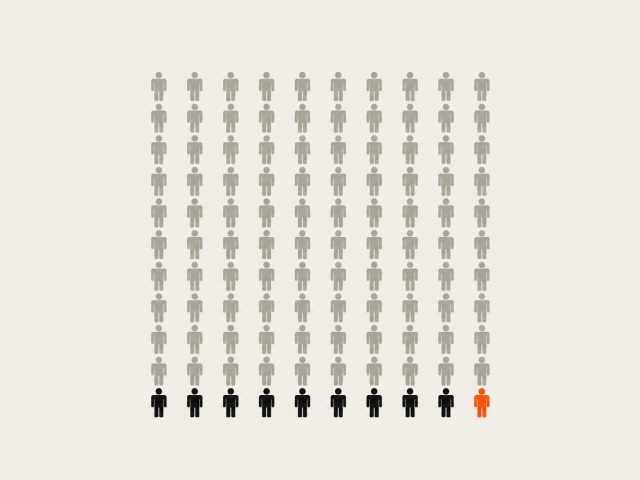
Your first pick had a 1 in 100 chance. The host has just walked past 98 goats and left a single door shut. Of course you switch. Switching wins 99 times out of 100. The three-door game is the same story at a smaller scale: 2 out of 3.
| Number of doors | Stay wins | Switch wins |
|---|---|---|
| 3 | 33.3% | 66.7% |
| 10 | 10% | 90% |
| 100 | 1% | 99% |
For n doors, staying wins 1 in n and switching wins (n minus 1) in n. We also ran a million simulated games for each of the 3-door and 100-door cases. Switching won 66.7% and 99.0%.
When the rule changes, the answer changes
Here is the part that makes the “obvious” takeaway wobble. The 2-in-3 result depends on the host knowing where the car is and always opening a goat door. Change that and switching can stop mattering.
Suppose the host forgets where the car is, opens one of the other two doors at random, and happens to show a goat. Now the odds really are a coin flip: staying and switching each win 50% of the time, once you only count the games where a goat was revealed. We simulated this too, and got 50.1%. In that version the host’s random pick wastes games: about one in three times he reveals the car and the game ends.
Vos Savant made the same point in a follow-up column: change the rules and you have a different question (Wikipedia, “Monty Hall problem”, quoting her 1991 follow-up). The puzzle is not about doors. It is about what the host knew and why he acted.
| Host behavior | Chance switching wins |
|---|---|
| Knows the car, always shows a goat | 66.7% (2 in 3) |
| Picks randomly, goat happens to appear | 50% |
Even pigeons figure it out
Researchers Herbranson and Schroeder (2010, as cited by Wikipedia) found that pigeons repeatedly exposed to a version of the problem learned to always switch. Humans did not. Experience, not cleverness, seems to be the cure. Instead of arguing from our gut, we can simply count what happens over many tries.
The takeaway
New information does not wipe out what you knew before. The host’s reveal told you something, but only about the door he picked, not about the door you picked.
When someone who knows the answer helps you, listen to what they chose not to do.
Sources
- Wikipedia, “Monty Hall problem” (1990 Parade column, letter counts, Erdős, pigeon study, vos Savant and Piattelli-Palmarini quotes), accessed 2026. link
- Own calculation and simulation (one million games per case; 3 doors, 100 doors, random-host variant), 2026.