Look at your pay stub and find the line called “health insurance.” It is probably a few hundred dollars a month. That feels like the price of your family’s coverage.
It is not. It is the part of the price you can see. There is a second, much bigger part that goes straight from your employer to the insurer, and it never shows up in your take-home pay.
The full price tag
Every year the Kaiser Family Foundation (KFF) surveys employers about health benefits. In the 2026 survey, covering more than 1,900 employers with at least 10 workers, the average annual premium for family coverage was $28,303. That is up 5% from 2025. Workers paid $7,471 of it, up 9%, or $621 (KFF, 2026).
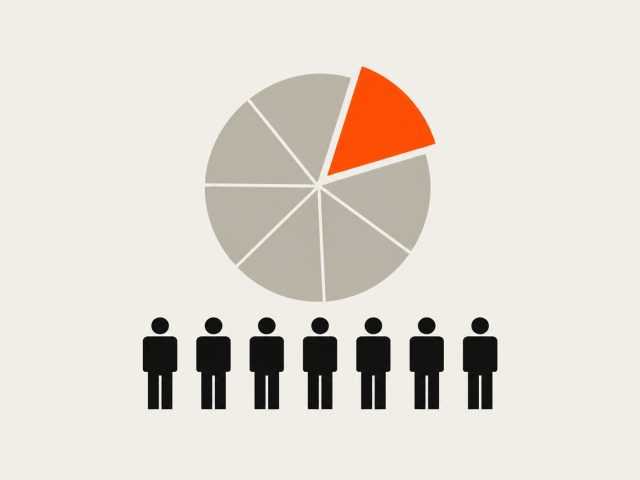
The rest, about $20,832, came from employers. That is our own subtraction, $28,303 minus $7,471. So the worker paid roughly 26 cents of each premium dollar, and the employer paid about 74 cents.
Then and now
The same survey series lets us look back. In 2015, KFF reported an average family premium of $17,545, with workers paying $4,955 (KFF, 2015).
| Family coverage | 2015 | 2026 | Change |
|---|---|---|---|
| Total premium | $17,545 | $28,303 | +61% |
| Worker pays | $4,955 | $7,471 | +51% |
| Employer pays (our subtraction) | $12,590 | $20,832 | +65% |
The percentage changes are our own arithmetic from the two surveys. Prices are not adjusted for inflation, so part of the rise is just the general climb in prices.
Over the last five years, KFF reports, family premiums rose 28%. Workers’ contributions rose 26%, wages rose 27% and inflation rose 24% (KFF, 2026). So over that stretch, premiums and wages moved at nearly the same speed. The 9% jump in the worker share this year, against wage growth of 3.7%, is the sharp part.
Here is another way to see it. In 2015 a family plan cost about $1,462 a month in total, with the worker covering about $413 of it. In 2026 the same measure is about $2,359 a month, with the worker paying about $623. Those monthly numbers are our own division of the yearly averages by 12.
How big is that against a paycheck?
The Census Bureau reports that median household income in 2025 was $87,460, before taxes and adjusted for inflation (Census Bureau, 2026). The median is the middle household: half earn more, half less.
Set the premium beside that figure and you get two ratios. The total family premium of $28,303 equals about 32% of $87,460. The worker’s share, $7,471, equals about 8.5%.
| Piece of the premium | Dollars per year | Share of $87,460 |
|---|---|---|
| Total premium | $28,303 | 32% |
| Employer part | $20,832 | 24% |
| Worker part | $7,471 | 8.5% |
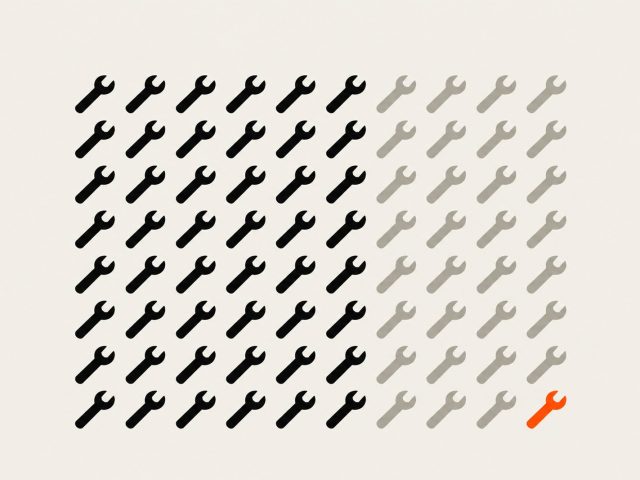
The health bill on your pay stub is only about a quarter of the real one.
numbergist.com (our own line, not a quotation)
Why that ratio can mislead
Now the caution. The 32% figure is a thought experiment, not a statistic about real families. We are putting a 2026 plan average beside a 2025 income measure, and they do not describe the same households.
The premium average covers only workers whose employers offer a plan and who take family coverage. The median household includes retirees, single people and many families with no job-based family plan at all. Many households would never see that bill.
The employer share also matters. It is money spent on the worker’s behalf, but it never reaches a bank account. The survey cannot tell us what any one worker would take home without it, so we leave that as a question, not a conclusion.
And the premium is not the whole cost. The average single-coverage deductible in 2026 was $1,955 (KFF, 2026). Deductibles, copays and prescriptions come on top.
Size matters too. At small firms with fewer than 200 workers, workers’ family contributions averaged $9,687, about $2,847 more than at larger firms (KFF, 2026).
What to take from it
Your pay stub shows about a quarter of the family health bill. The rest is paid out of sight, and it has grown about 60% in eleven years.
It is easy to feel that wages stall while costs climb. This is one place where the invisible half is doing much of the climbing.
For illustration only. Not financial advice.
Sources
- KFF, “2026 Employer Health Benefits Survey” (news release: “Workers now pay $7,471 on average annually for family health coverage”), October 22, 2026. link
- KFF, “Employer family health premiums rise 4 percent to $17,545 in 2015”, press release, 2015. link
- U.S. Census Bureau, “Median Household Income in 2025 Surpassed Previous Highs Before and After the COVID-19 Pandemic”, September 2026. link