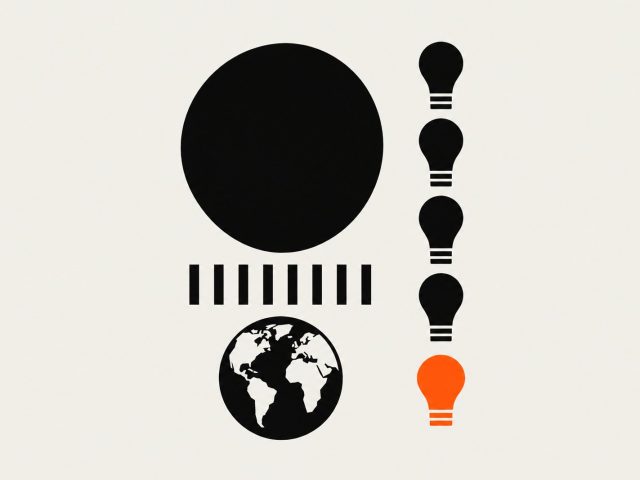
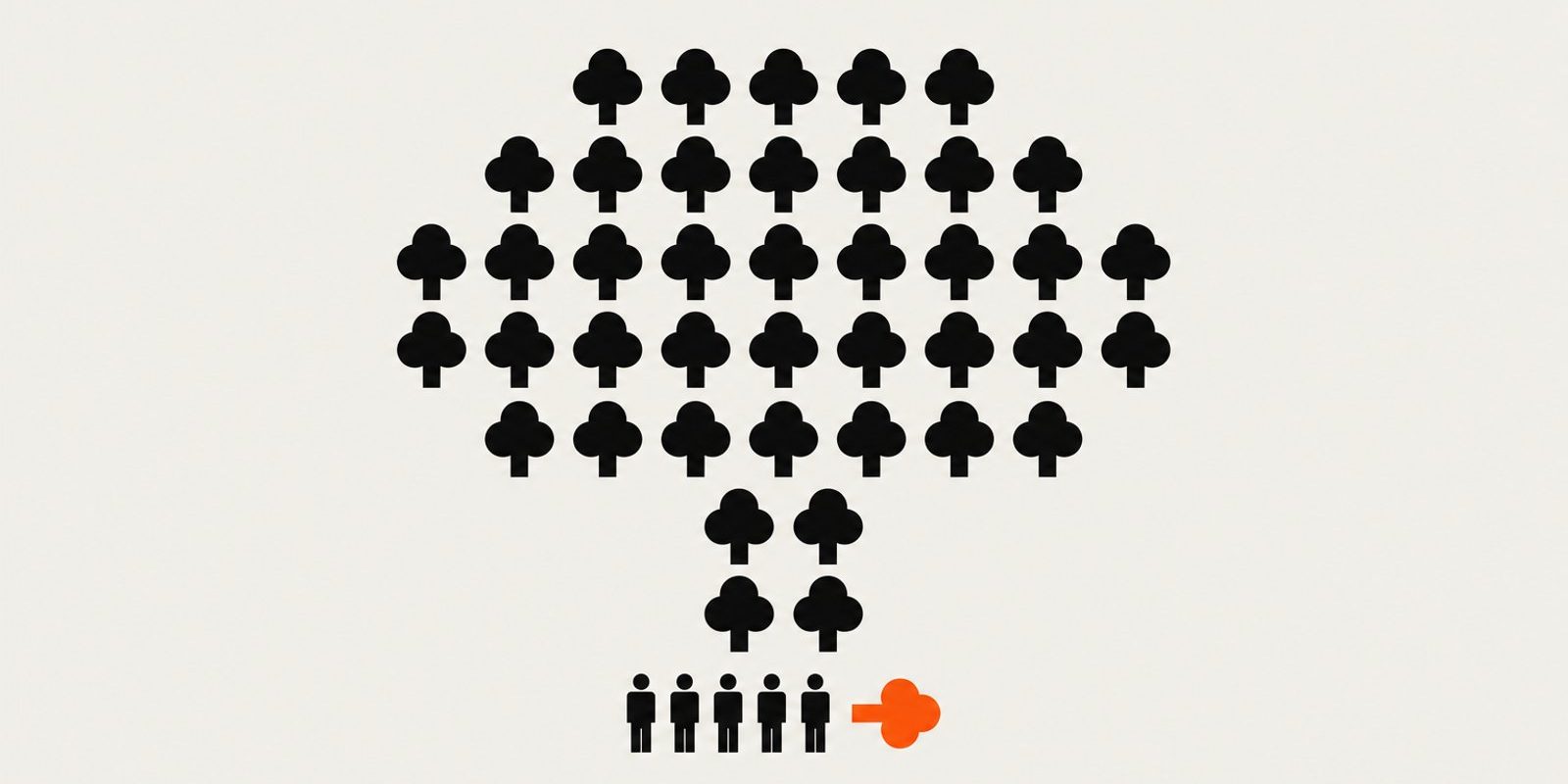
Walk through a city park and count the trees you can see. Maybe a few dozen. Now imagine you own your fair share of every tree on the planet.
It would not be a few dozen. It would be hundreds. A 2015 study counted roughly 3 trillion trees on Earth, and that works out to hundreds of trees for every person alive.
The count that changed the guess
The study, led by Thomas Crowther of Yale and published in Nature, put the global total at about 3.04 trillion trees. At the time, that was roughly 422 trees per person (Crowther et al., Nature, 2015). The world has added people since. Spread across about 8.2 billion people (UN DESA, 2024), the same 3.04 trillion trees comes to about 370 each. The tree count is from 2015, so that is a rough update, not a new measurement.
Before this study, the usual figure was just over 400 billion trees, or about 61 per person. That estimate leaned on satellite images and forest-area figures, with no counting on the ground (Yale School of the Environment, 2015). The new count was about 7.6 times larger.
How do you count a trillion trees?
Nobody walked the whole planet. The team gathered tree counts from more than 400,000 forest plots, taken from national forest inventories and published studies (Yale School of the Environment, 2015). A plot is a small patch where someone really counted every tree.
Then came the satellites. The researchers linked the plot counts to what satellites could see and measure: climate, terrain, vegetation, soil and human impact. That let them predict tree density for every square kilometer of land, including places no one has counted. They did the map-making; the ground crews did the counting.
The result shows where the trees are. The tropics hold about 43% of them, boreal forests in the far north about 24%, and temperate zones about 22% (Yale School of the Environment, 2015).
Why the old number was so low
Satellites are good at seeing forest canopy from above. They are not good at counting the trees under it. Dense, mixed forests look much the same from orbit whether they hold a few hundred trees per hectare or many more. So the older estimates, built from the sky down, ended up far below what ground counts showed.
The new method started on the ground and used satellites to fill in the gaps. That is the main reason the answer jumped by a factor of about seven.
| Estimate | Total trees | Trees per person (at the time) |
|---|---|---|
| Earlier satellite-based estimate | just over 400 billion | about 61 |
| Crowther et al., 2015 | 3.04 trillion | about 422 |
The catch: that is a count, not good news
Hearing “3 trillion trees” can make forests sound safe. They are not. The same study estimated that over 15 billion trees are removed each year through deforestation, land-use change and forest management. That is a gross figure, so replanting and regrowth offset some of it. Still, the authors estimated that the number of trees has fallen by about 46% since human civilization began (Crowther et al., 2015). Working backward, that implies roughly 5.6 trillion trees before people started cutting. That last number is our own arithmetic, not a figure from the paper.
We’ve nearly halved the number of trees on the planet, and we’ve seen the impacts on climate and human health as a result.
Thomas Crowther, Yale University (PBS NewsHour, 2015)
The satellite record backs up the trend, though it measures something different. Global Forest Watch reported about 30 million hectares of tree cover loss in 2024, a record, driven largely by fire (Global Forest Watch / WRI, 2025). That is area, not a tree count. It also includes forest that can grow back, such as burned land and harvested plantations. The two numbers cannot be converted into each other, so treat them as two views of the same pressure.
What 15 billion a year means
Fifteen billion trees a year sounds huge against 3 trillion, because it is a small slice: about half a percent. But it adds up. Divide it out and it is nearly 480 trees every second. It is also about 1.8 trees per person each year, every year. At that rate, with no regrowth at all, the world’s trees would last about 200 years. That is a thought experiment, not a forecast.
The count is also an estimate with uncertainty. It comes from a model, and later work has refined parts of it. The 2015 number remains the standard answer to the question “how many trees?”, but it is a snapshot, not a live counter.
Each of us has hundreds of trees on Earth, and we are cutting about two per person every year.
Sources
- Crowther, T. W. et al., “Mapping tree density at a global scale”, Nature 525, 201-205, 2015. link
- Yale School of the Environment / Yale News, “Seeing the forest and the trees: all 3 trillion of them”, 2015. link
- PBS NewsHour, “How many trees are there on Earth?”, 2015. link
- United Nations DESA, “World Population Prospects 2024”, 2024. link
- World Resources Institute / Global Forest Watch, “Global Forest Loss Shatters Records in 2024, Fueled by Massive Fires”, 2025. link